Explainer8 min • 2026-10-25
What is the difference between open-weight and closed AI models?
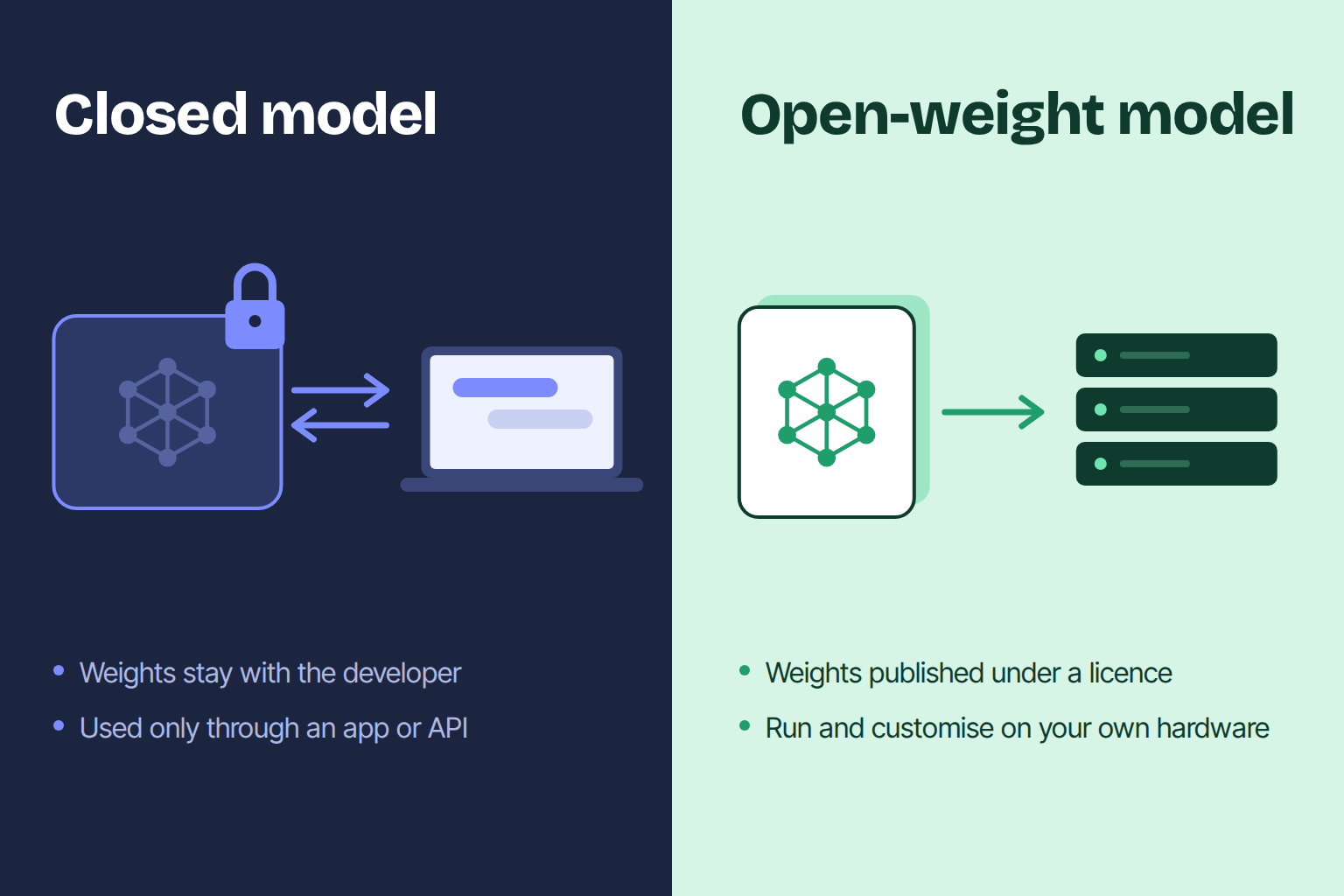
https://aibriefingnews.com/explainers/what-is-an-ai-agent-and-how-is-it-different-from-a-chatbot-4c8aWhat model weights are, how open-weight and closed models differ in practice, and why "open" rarely means open source.The basicsA hospital wants AI to summarise patient notes. It can send the notes over the internet to an AI company and get summaries back, or it can download a model's files, run it on its own servers and never let a single note leave the building. The first route uses a closed model. The second uses an open-weight model.The difference comes down to one thing: who holds the weights. During training, a model learns billions of numbers, called weights or parameters, that decide how it turns an input into an output. The Open Source Initiative (OSI), the body that maintains the standard definition of open source software, describes weights as the learned values that sit on top of a model's design and produce its answers. Hold the weights and you hold a working copy of the model.With a closed model, the developer keeps the weights on its own servers. You reach the model through a chat app or an API (application programming interface), a channel that lets your software send requests and receive responses. You never see or touch the model itself.With an open-weight model, the developer publishes the weight files for download, usually on a public hosting site, under a licence that sets the rules for using them.A car makes a useful comparison. A closed model is a taxi service: you choose where to go and pay per trip, but you never touch the engine. An open-weight model hands you the keys: you can drive the car anywhere and modify it, but you do not get the factory blueprints. Fully open source AI is the car plus the blueprints plus the parts list.How it worksOpenness is a spectrum rather than a switch, with three broad levels.Closed. The weights, training data and training code all stay private. You get answers, not the model.Open-weight. The weights are published. The training data, and often the code used to train the model, stay private.Open source. Under the OSI's Open Source AI Definition 1.0, released in October 2024, a model counts as open source only if the developer shares the weights, the full code used to prepare data and train the model, and enough detail about the training data that a skilled person could build a substantially equivalent system. The definition does not require the data itself to be published, a compromise that drew criticism from some in the open source community.Most models people call "open source" sit at level two.Running the model. Downloading the weights is only the start. You need hardware strong enough to run them, either your own or rented from a cloud provider. Small open-weight models run on a laptop. The largest do not. Mistral Large 4, which the French company Mistral put into public preview in October 2026, has about a trillion parameters, of which roughly 49 billion are used for each token it processes (a token is a word or a piece of one). It uses a design called mixture of experts, in which the model is split into many specialist sub-networks and only a few switch on for any given piece of text. Even so, it is far too big for a desktop.Changing the model. Open weights allow fine-tuning: further training on your own data so the model gets better at a narrow job, such as reading contracts in one jurisdiction. You can also inspect the model's internals, compress it to run on cheaper hardware or combine it with other models and tools, for example as the engine inside an AI agent. With a closed model, any customisation happens only through whatever tools the developer chooses to offer.The licence. The weight files come with a licence, and its terms vary widely. Some are permissive: Mistral Large 3 shipped under Apache 2.0, a standard licence that allows commercial use and modification with few conditions. Others add limits. Meta's Llama community licences require a separate agreement with Meta for any product with more than 700 million monthly users, and the Llama 3 licence restricted using the model's outputs to improve rival models. As of 25 October 2026, Mistral is expected to release Large 4's weights under a custom licence of its own rather than Apache 2.0.Why it mattersThe choice between open and closed shapes who controls an AI system, what it costs and how it can be governed.Control and data. A company running open weights on its own servers decides where its data goes, which version of the model it uses and when to upgrade. A closed provider can change, reprice or retire a model on its own schedule. Mistral pitches its open weights partly on this basis, as protection against a vendor switching a capability off. That is a selling point from a company with a stake in the answer, but the underlying trade is real.Capability. Closed models have generally held the lead. The research group Epoch AI, which tracks AI progress, found that since January 2026 the most capable open-weight models have trailed the best closed models by about four months on its Epoch Capabilities Index, a combined score built from many benchmarks. That gap was slightly wider than the three month average it measured between January 2023 and October 2025.Cost. Open weights carry no per-request fee to the developer, but someone pays for the chips, the electricity and the engineers who keep the system running. Whether that beats paying per use depends on how much a team uses the model and whether it already has the hardware.Safety and policy. Once weights are published, they cannot be recalled, and anyone with the files can retrain away the safeguards the developer built in. Closed developers, by contrast, can watch for misuse and cut off access. Governments have weighed both sides. In July 2024, the US National Telecommunications and Information Administration (NTIA), part of the Commerce Department, concluded after a public consultation that the government should not restrict open model weights at that time, recommending close monitoring instead and keeping the option to restrict certain models later. It judged open models by their marginal risk: the extra harm they add beyond what other available tools already allow.Common misconceptionsOpen-weight means open source.Usually it does not. Under the OSI definition, open source AI also needs the training code and detailed information about the training data. Most open-weight releases share neither, which is why the more precise term has caught on.If I can download it, I can use it however I like.The licence decides. Some allow almost anything. Others cap the size of the business using them, limit what outputs can be used for or ban certain uses outright. Reading the licence is part of choosing the model.Open models are years behind.On Epoch AI's measure, the gap has been a matter of months, not years, and the best open-weight models match where the closed frontier stood only recently.Running it yourself is always cheaper.Hardware, hosting and staff cost money. For light or irregular use, paying per request to a closed provider can work out cheaper. The economics tend to favour open weights at high, steady volume.Closed is safe and open is dangerous.Each carries different risks. Closed models concentrate control in one company, which can monitor and block misuse but also decides alone what the model may do. Open weights allow outside researchers to inspect and test a model, but they also put it beyond the developer's reach once released.What's nextAs of 25 October 2026, four questions shape how this plays out.Licences. Developers keep experimenting with custom terms that sit between fully permissive and closed. Mistral's planned Large 4 weights release, due 27 October 2026 under its own licence, is the next test of where the line falls.The gap. Whether open-weight models close in on the frontier or fall further behind as training costs rise.Rules. Governments are still deciding how to treat published weights, especially for the most capable models.Safeguards. Researchers are looking for protections that survive once a model has been downloaded and retrained.