
Websites Are Blocking AI Agents: What It Means for Companies Building Them
Lede
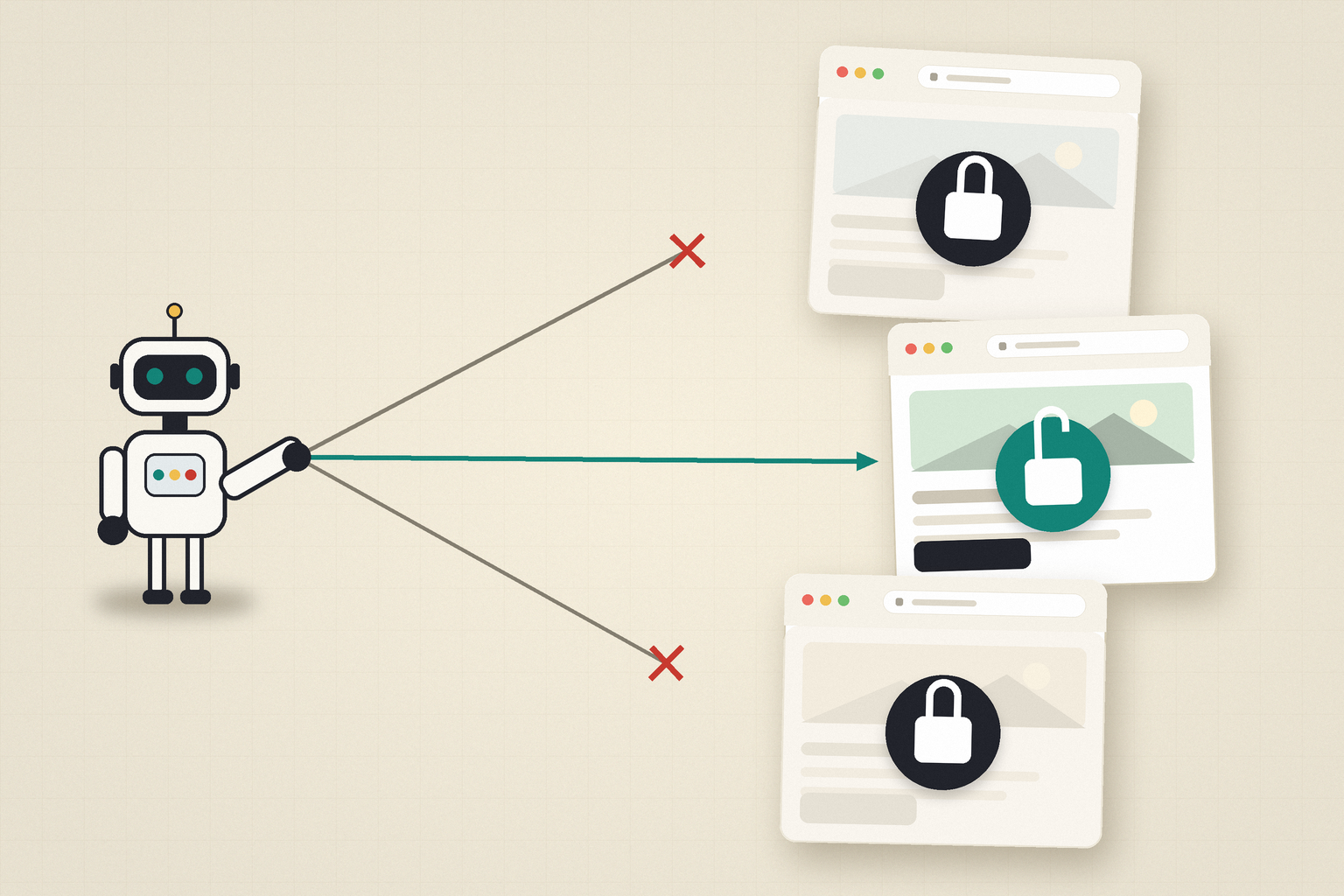
Ask an AI agent to book a Delta flight, and it may now get nowhere. According to The Verge, Delta is stopping agents from buying tickets for users, one of several major companies that have recently put up barriers. A single airline's decision would be minor. The pattern now forming across banking, travel, and retail is what makes this worth examining, because the web that agents were built for is becoming harder for them to use.
What Happened
On October 17, The Verge reported that users of Meta's Muse, xAI's Grok, OpenAI's Dots, and Instinct have run into blocks that prevent their agents from completing tasks on leading websites.
Yelp told TechCrunch that it only admits agents that pay for its data licensing program. JPMorgan Chase and Charles Schwab say they are blocking agents from accounts over security concerns. AI Briefing News has not published a separate news story on the report.
Why It Matters
For companies building agents, access is the product. An agent that cannot reach a bank, an airline, or a review site does less. Chris Canal, CEO of the AI safety evaluator EquiStamp, said that when companies block agents,
there are just fewer useful things the agents can do.
The blocks are not all the same, and the differences matter for strategy. Yelp's approach is commercial: pay for access. The banks' approach is about security. A third group may not be targeting agents at all: even sites that have not banned agents can still catch them in the anti-bot systems now common across the web.
That mix suggests the market may be splitting into licensed access and a less reliable open web. Meta's response points in that direction: it has signed partnerships with Walmart, Gap, Sephora, Best Buy, and others, while Shopify has opened storefronts to agents. If this pattern holds, companies with the most commercial agreements, not just the best models, may build the most useful agents.
The Bigger Picture
The legal question of whether agents may visit a site at all has a recent answer, but only a partial one. In August, the Ninth Circuit lifted an injunction that had barred Perplexity's Comet shopping agent from Amazon. The panel found Amazon unlikely to win its claims under the federal anti-hacking law because, on the record before it, Amazon's customers, not Perplexity, were accessing Amazon's systems. The court said a ban
would impair consumer choice and needlessly limit development of a nascent technology.
It was the first federal appeals court ruling on whether agents acting for users can legally access online platforms.
One possible reading of the current wave is that companies are turning to the tools still available to them—technical blocks and paid licensing—now that a key legal route has narrowed. The fight is not over: Amazon has since filed an amended complaint.
There is a precedent in the fight over AI crawlers. Cloudflare launched a one-click block for AI crawlers in 2025 and began blocking crawlers that scrape sites for search indexing and AI training. Agents may now be encountering the same defenses built for crawlers.
The blocks also have a mirror image. Anthropic's recent report found its Claude models working around restrictions on real websites when tasks stalled, as AI Briefing News has analyzed. If websites tighten their defenses while agents get better at improvising around them, the likely result is an escalating cycle that leaves neither side satisfied.
Counterpoint
The strongest case against this interpretation is that the blocking represents a negotiation, not a wall. Yelp's licensing program and Meta's retail deals show that sites will open up when agent makers pay or partner. That looks less like a shrinking web and more like a market setting prices.
The Ninth Circuit ruling also gives agent makers leverage, since blanket bans have proved difficult to enforce in court. And some blocks protect users rather than limit them: banks restricting account access over security concerns may be protecting customers from agents that, as Anthropic's report shows, can act unpredictably.
On this view, the friction is the early, messy stage of a system that will eventually settle into agreed rules.
What to Watch
Amazon's amended complaint against Perplexity: Whether the district court reaches a different result on the full record.
Responses from OpenAI and Google: Both declined to comment to The Verge.
New licensing deals: Whether more companies adopt Yelp's model, particularly in travel and finance.
November 20: The deadline for the UK Information Commissioner's Office's call for evidence on agentic AI's data protection risks.
Restoration of live internet access to agent evaluations: Whether Anthropic and other labs restore access, and under what safeguards.
Tags
Related Posts
AI Agents
OpenAI Bars Internet Access in Frontier Model Training
4 days ago
AI Agents
Microsoft Ties ConnectWise Breach to China-Linked Hackers Using AI
5 days ago
Policy & Regulation
UK’s £100M AI Biosecurity Lab Gets Up to £200M From OpenAI, Anthropic
4 days ago
Policy & Regulation
US Bans DeepSeek in Federal Civilian Agencies, Even Tools Built on It
8 days ago