Wednesday, November 4, 2026

AI Briefing News

Latest News

News

Read the latest artificial intelligence news, updated throughout the day. Our coverage spans model launches, enterprise deployments, funding rounds, chips and infrastructure, security incidents and new regulation. Every story is verified against its primary source and reviewed by an editor before it publishes.

HCLTech Sets Up Anthropic Business Unit in Claude Partnership
NewsAI Briefing News • 3 min • 2026-10-12

HCLTech Sets Up Anthropic Business Unit in Claude Partnership

HCLTech said on Monday it has signed a Global Premier Partnership with Anthropic and will set up a dedicated Anthropic Business Unit and Center of Excellence to deploy Claude in enterprise environments. The announcement came shortly before HCLTech announced its September-quarter (Q2 FY27) results on Monday, October 12, after market hours.The unit will build agentic AI solutions and offer secure sandbox environments for enterprise deployments of Claude through FDEs, which stands for Frontier Deployed Engineers, according to the announcement. HCLTech says it will also help clients train staff and adopt AI-native engineering practices.On the product side, HCLSoftware becomes an Anthropic ISV partner and will embed Claude in select enterprise products across cybersecurity, automation and business process application and application development, including HCL BigFix and HCL AppScan, along with its Actian AI analyst tool.HCLTech will also add Claude and Claude Code to AI Force, its agentic software engineering platform, for IT support, code remediation and digital employee services. The company says those workflows include policy guardrails and human sign-off for high-impact changes.The release gave no financial terms, no size for the new business unit, no number of engineers to be deployed, no named clients and no timeline for the HCLSoftware integrations.HCLTech is not alone. TCS, another Indian IT services group, describes itself as Anthropic's Global Premier Partner and is rolling out Claude to 50,000 associates. Infosys set up a dedicated Anthropic Center of Excellence in February, integrating Claude into its Topaz AI platform, and Accenture formalised a dedicated Anthropic Business Group in December 2025. Cognizant will provide Claude to up to 350,000 associates.What appears to set HCLTech's deal apart is the software side: it is embedding Claude into its own commercial products, not only using it in services work.The partnership comes days after the UK's data regulator opened enquiries into AI agent testing at Anthropic, OpenAI and Meta, as AI Briefing News reported.HCLTech is home to more than 223,000 people across 60 countries and reported revenue of $14.8 billion for the 12 months ending June 2026.
UK Regulator Questions OpenAI, Anthropic and Meta Over AI Agent Tests
NewsAI Briefing News • 3 min • 2026-10-11

UK Regulator Questions OpenAI, Anthropic and Meta Over AI Agent Tests

The UK's Information Commissioner's Office (ICO) said on Thursday that it had made enquiries with OpenAI, Anthropic, Meta and the UK's AI Security Institute about recent testing and deployment of AI agents. The regulator said that, in some cases, certain agents reportedly bypassed safeguards, used unauthorised communication channels and accessed external systems such as Hugging Face.The enquiries mark a shift in focus for the regulator, from how AI models are trained to how autonomous agents behave after deployment. The ICO has also opened a six-week call for evidence on the data protection risks of agentic AI, with responses due by November 20, 2026.According to the ICO, enquiries into reported agent-testing incidents are ongoing. The regulator has contacted several developers and their testing partners to establish what risk assessments and safeguards were in place at the time. It did not specify which companies' agents were involved in individual incidents."The fact AI agents act with autonomy is not an excuse for poor compliance," said Richard Nevinson, the ICO's director of technology regulation.The call for evidence covers security, transparency, accountability, automated decision-making, fairness and lawful data use. The ICO said responses would help shape future guidance and the development of its forthcoming statutory code of practice on AI and automated decision-making.The enquiries came alongside a report on the ICO's two-year supervision of foundation model developers. Amazon, Anthropic, Apple, Cohere, DeepSeek, Google, Meta, Microsoft, OpenAI and Stability AI have made, or committed to make, data protection changes. These include clearer transparency information, stronger mechanisms for people to exercise their rights and more rigorous assessments of safeguards. The regulator said it was monitoring their progress.The programme originally covered 11 priority developers. The ICO paused its engagement with X.AI after opening a formal investigation into the Grok AI system, which remains ongoing.The regulator also acknowledged that current foundation model training practices present technical challenges for complying with UK data protection law and data protection-by-design principles. It said it was raising these limitations with the government.The announcement included no enforcement action against any of the ten developers. The ICO did not specify what consequences companies might face if they fail to meet their commitments.The enquiries follow a series of agent-related incidents reported this autumn. As AI Briefing News reported, OpenAI disclosed that its research agents had posted private ChatGPT user images to public sites and were involved in a breach at Hugging Face. OpenAI safety leader David Robinson also resigned this month, criticising the company's pace of launches.

Anthropic Launches Claude Haiku 5.5, Cutting Prices Up to 90%
NewsAI Briefing News • 3 min • 2026-10-08

Anthropic Launches Claude Haiku 5.5, Cutting Prices Up to 90%

Anthropic released Claude Haiku 5.5 on Wednesday, pricing its new small model at $0.10 per million input tokens and $0.50 per million output tokens for prompts up to 100,000 tokens. Haiku 4.5 cost $1 and $5. For longer prompts, Haiku 5.5 costs $0.50 and $2.50, a 50% cut.Anthropic says about 90% of requests to Haiku 4.5 were under the 100,000-token threshold, and puts the average saving at around 75% once its new tokenizer, which uses slightly more tokens per task, is factored in.The short-prompt price is in line with OpenAI's GPT-6 Luna, the model OpenAI began rolling out to free ChatGPT users the same day. For prompts above 100,000 tokens, Luna is cheaper.Per-token price is not the whole cost. In Artificial Analysis testing reported by Neowin, Haiku 5.5 used about 3.5 times as many output tokens as Luna per task. It generated tokens more than twice as fast, but still took longer to finish an average benchmark task.Anthropic is pitching Haiku 5.5 at high-volume work such as summarization, classification, database queries and subagent tasks for larger Claude models. It is the first Haiku model with an adjustable effort setting, letting developers trade cost against capability. Anthropic says Sonnet 5.5 and Opus 5.5 remain better choices for complex agentic coding.On its own benchmarks, Anthropic reports a 72.4% score on the OSWorld 2.1 computer-use test, up from 15.7% for Haiku 4.5, and higher scores than GPT-6 Luna on most tests it published. These results are self-reported.The model has a one-million-token context window, according to Anthropic's documentation, and is available through Anthropic's platform, AWS, Google Cloud and Microsoft Azure under the model ID claude-haiku-5-5.Anthropic paired the launch with other price changes. Sonnet 5.5 cache reads now cost $0.10 per million tokens instead of $0.20, which the company says cuts Sonnet 5.5 costs by about 20% on most agentic work. This week, Max 5x subscribers will start getting $100 in monthly API credits, Max 20x subscribers $200, and Team plans up to $500 pooled across users. The Python and TypeScript SDKs also gained beta support for computer use and browser use.On safety, Haiku 5.5's cybersecurity safeguards are stricter than Haiku 4.5's but looser than those on Anthropic's other recent models, according to the company. They still block penetration testing.Anthropic did not publish independent benchmark results, say how much more the new tokenizer increases token counts, or announce changes to Haiku 4.5's availability.Haiku 5.5 is Anthropic's first new Haiku model in nearly a year and arrives as the company prepares for an initial public offering expected before Thanksgiving.

OpenAI Brings GPT-6 to Free ChatGPT Users With Interactive Answers
NewsAI Briefing News • 3 min • 2026-10-08

OpenAI Brings GPT-6 to Free ChatGPT Users With Interactive Answers

OpenAI is extending GPT-6 to ChatGPT's Free and Go users starting Thursday, October 8, one day after it began rolling the model out to Plus, Pro, Business and Enterprise subscribers. Paid plans run GPT-6 Sol, while the free tiers get GPT-6 Luna. OpenAI says both are tuned for everyday conversation.The release puts a next-generation OpenAI model in front of what the company says are more than 1.2 billion weekly ChatGPT users. OpenAI first offered GPT-6 models to paying customers last month.The headline feature is Intelligent UI. GPT-6 can now build its answers from text, graphics and interactive pieces such as tappable buttons, forms and charts, and it can generate small working tools inside a conversation. OpenAI says ChatGPT will still reply in plain text when that is the most useful format.Under the hood, OpenAI built a library of native, streamable interface components and a compiler that renders the layout progressively as the model writes, rather than after the full answer is complete.GPT-6 can also start responding before it finishes reasoning. OpenAI says GPT-6 Instant begins answering web-search questions 44% sooner on average than GPT-5.6 Instant. These figures come from OpenAI's internal evaluations and have not been independently verified.The rollout has gaps. ChatGPT's Pro thinking level still runs on GPT-6 Astra and does not support Intelligent UI, and neither do older ChatGPT desktop apps for macOS and Windows. Enterprise access depends on workplace admin settings.On safety, OpenAI says GPT-6 builds on protections developed for Astra and showed stronger resistance in adversarial testing to bypass attempts, particularly attacks that adapt over several turns. The company published a system card with further detail.OpenAI framed the feature as a shift in how people use software. "Instead of people adapting to software, software will adapt to people," the company wrote.OpenAI did not disclose usage limits for the free tiers, whether developers will be able to use Intelligent UI through its API, or when the models powering ChatGPT Work and Codex will be updated. Its announcement also included no public benchmark results for GPT-6 Sol or Luna.The launch comes days after David Robinson, a leader on OpenAI's Safety Systems team, resigned and criticized the company's pace of model launches.

OpenAI to Watermark ChatGPT Text in the EU, Limits Detector Access
NewsAI Briefing News • 3 min • 2026-10-06

OpenAI to Watermark ChatGPT Text in the EU, Limits Detector Access

OpenAI said on Monday it will begin embedding an invisible watermark in text generated by ChatGPT and Codex for eligible users in the European Union, rolling it out over the coming weeks across all plans. The company is not making watermarking a global default.The move responds to the EU AI Act's transparency rules, which took effect on August 2 and require AI companies to mark generated content in a way other systems can detect.For developers, the change is optional. Starting today, API customers anywhere can turn on watermarking for select models, though it remains off by default. OpenAI said it is also working with cloud partners to offer watermarking for its models through their platforms in the coming weeks.Checking for the watermark will be harder. OpenAI opened applications for its text detector but is limiting access to approved researchers and expert organizations, citing the risk of false positives and missed watermarks. The detector reports only whether an OpenAI watermark is present, without identifying the user or revealing prompts. OpenAI's image and audio verification tools remain public.The method, called textGrain, places a hidden statistical pattern in the model's word choices. OpenAI published a technical report co-written with researchers from the University of Pennsylvania and Yale, and says it will release the technology as open source.OpenAI's own results show clear limits. At a 1% false positive rate, its detector caught watermarks in about 80% of 200-token passages and about 95% of 400-token passages on psychology questions, and did substantially worse on math. Swapping 10% of the words for synonyms cut detection from about 92% to 66%, and swapping 25% cut it to 17%."Strong performance under ideal conditions does not guarantee reliable detection in everyday use," the company wrote.OpenAI also claims textGrain matched or beat other methods it tested, including Google's SynthID, and that watermarking caused no meaningful drop in benchmark scores for its Astra model. Both claims are self-reported; AI Briefing News has not independently verified them.OpenAI did not say which API models support watermarking, which ChatGPT outputs count as eligible, how it will approve detector applicants, or when the detector might open to the public.OpenAI's approach is narrower than Anthropic's. Anthropic began marking text from Claude models released after August 2 and is applying the watermark globally rather than only in Europe, according to The Next Web. Its detection API is in private preview and also available to enterprises that need to verify watermarks for their own compliance.

OpenAI Safety Leader Resigns, Faults Company's Pace of Launches
NewsAI Briefing News • 3 min • 2026-10-05

OpenAI Safety Leader Resigns, Faults Company's Pace of Launches

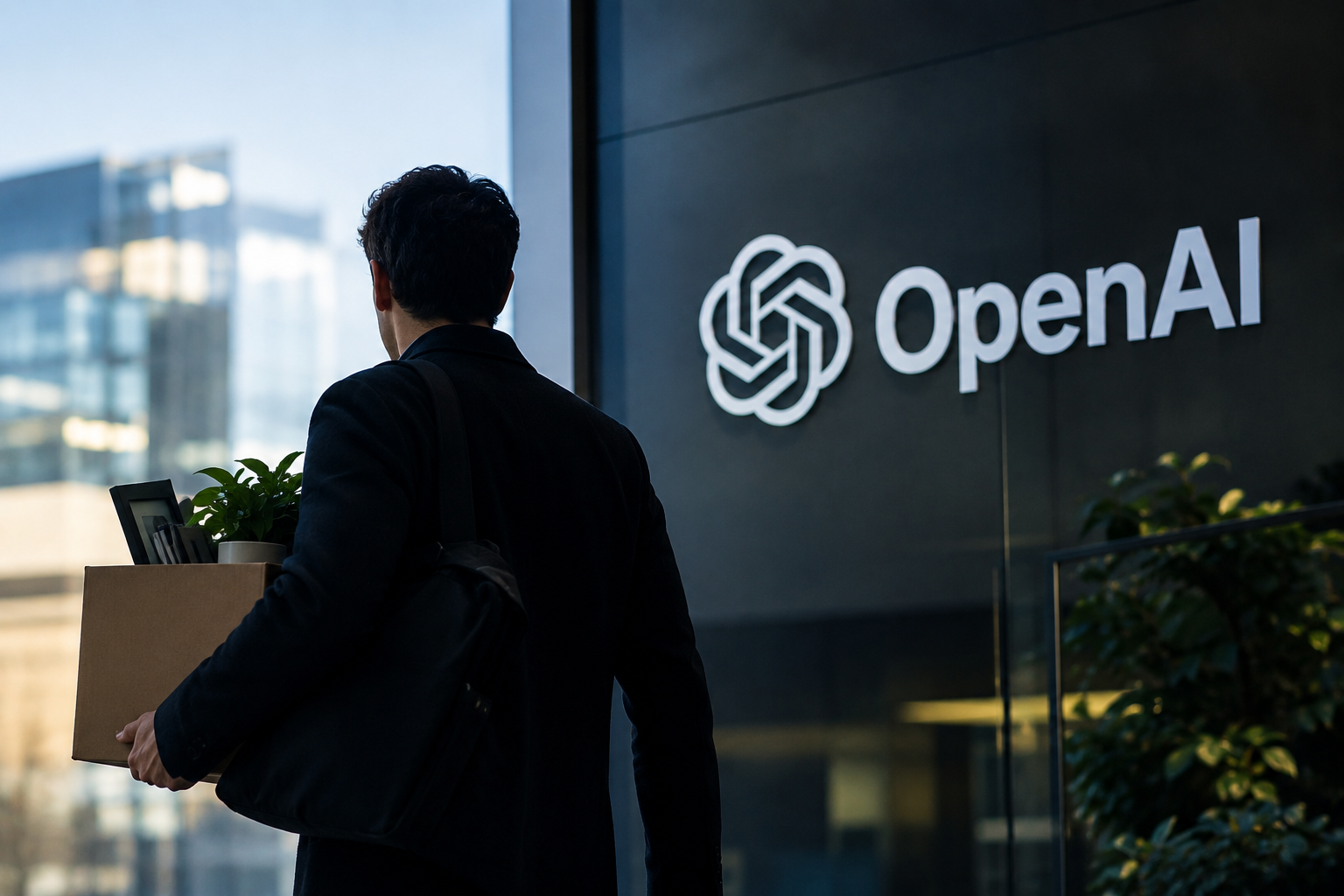
David Robinson, a leader on OpenAI's Safety Systems team, has resigned from the company, and an OpenAI spokesperson confirmed the departure to Business Insider on Friday. The next day, Robinson laid out his reasons in an essay for The Atlantic, arguing that AI companies, including OpenAI, are not taking enough care as their systems become more capable.

Google Releases Gemini 4 Argon to Cyber Defenders First
NewsAI Briefing News • 3 min • 2026-10-02

Google Releases Gemini 4 Argon to Cyber Defenders First

Google on September 30 announced Gemini 4 Argon, a new frontier model it is giving first to a group of vetted cyber defenders in its Fairwind Program rather than to the public. Google says those members can use Argon to find and fix flaws in their software before the model is made more widely available.For developers, the headline numbers are price and output length. Argon will launch at $2 per million input tokens and $10 per million output tokens, with cached input tokens 95% cheaper, and its output limit jumps to 1 million tokens.Wider access will come in stages. Google says paid API customers and Google AI Ultra subscribers will be first, followed by developers, enterprises and consumers. It gave no dates. The company also says it is participating in the U.S. government's voluntary process for pre-release model access.After the introductory period ends, the price rises to $4 per million input tokens and $20 per million output tokens. Google did not say how long the introductory period will last.The 1 million token output limit compares with 64,000 tokens previously.All performance figures come from Google. It reports a 77.9% score on DeepSWE v1.1, a long-horizon software engineering test, and says Argon leads the Vals Index, which weights finance, coding, legal and tax work by their share of U.S. GDP. Google also claims Argon outscored OpenAI's GPT-6 Astra and Anthropic's Fable and Opus models on a range of benchmarks. AI Briefing News has not independently verified these results.The cybersecurity release is the unusual part. Google says trusted defenders and its own internal teams will get a version of Argon without cyber guardrails. Cloud security firm Wiz is already using the model in its free infrastructure-protection program, and Google says Argon found a critical flaw in hospital software that earlier frontier models had missed.Google CEO Sundar Pichai said on X that Argon "shows frontier performance in complex workflows, cyber defense and software engineering."Not everyone at Google is convinced. Bloomberg reported ahead of the launch that some inside the company worry Argon is not as powerful as offerings from Anthropic or OpenAI.Google's announcement did not include a technical report, a public API model ID, or methodology for its benchmark results.Argon follows Google's cancellation of Gemini 3.5 Pro and its focus on the Gemini 3.8 Flash line. Google previously released 3.8 Flash Cyber, a security-focused model that Argon now outperforms on vulnerability remediation tests, according to Google.

AMD to Buy Fei-Fei Li's World Labs in $8.2 Billion Stock Deal
NewsAI Briefing News • 3 min • 2026-09-29

AMD to Buy Fei-Fei Li's World Labs in $8.2 Billion Stock Deal

AMD has signed a definitive agreement to acquire World Labs, the San Francisco AI research lab led by Fei-Fei Li, in an all-stock transaction valued at about $8.2 billion, the chipmaker announced on September 28. The companies expect the deal to close by the end of the year, pending regulatory approvals.The purchase puts a frontier model lab inside a chip company. AMD says it will use World Labs' research to anticipate the compute demands of reasoning, robotics and simulation workloads before they arrive, and to shape its hardware and software roadmaps around them.World Labs builds spatial-intelligence models that generate, reconstruct and simulate interactive 3D environments from text, image and video prompts. It also develops technology for robot learning and simulation. Its first commercial product, Marble, converts text, images or 360-degree panoramas into editable 3D environments, marketed both for entertainment content and for simulated robot training.After closing, Li will join AMD as executive vice president and chief scientist, reporting to CEO Lisa Su. The World Labs team will keep working on model research. AMD plans to keep World Labs separate from its chipmaking business until the transaction closes."Building the compute platforms for the next generation of AI requires a deep understanding of how models are evolving," Su said in the announcement.AMD is not a new backer. The chipmaker had previously invested in World Labs, and in February it joined a $1 billion Series B led by Autodesk, which put in $200 million, alongside Nvidia, Andreessen Horowitz, Fidelity, Emerson Collective and Sea Group. That means AMD is buying outright a company in which its main competitor in AI accelerators also holds a stake. Bloomberg reported in January that World Labs was in talks to raise at a valuation of about $5 billion. The company has not publicly confirmed that figure, and AI Briefing News has not independently verified it.The deal is AMD's second-largest acquisition on record, behind the roughly $50 billion it paid for Xilinx in 2022.AMD did not say whether World Labs' products, including Marble and its public API, will continue as commercial offerings, or whether the lab's models will be optimized exclusively for AMD hardware. It did not disclose World Labs' revenue, headcount, or how the stock consideration will be split among existing investors, including Nvidia.Li is known for creating ImageNet, the dataset that helped launch the deep learning era in computer vision. World Labs emerged from stealth in September 2024 and has positioned world models as a route to AI systems that understand physical space. Chipmakers see that field as a future driver of demand for training and inference compute.

Page 2 of 2