
What is an AI agent, and how is it different from a chatbot?
What an AI agent actually is, how the loop behind it works, where it still fails, and how to tell a real one from a rebrand.
The basics
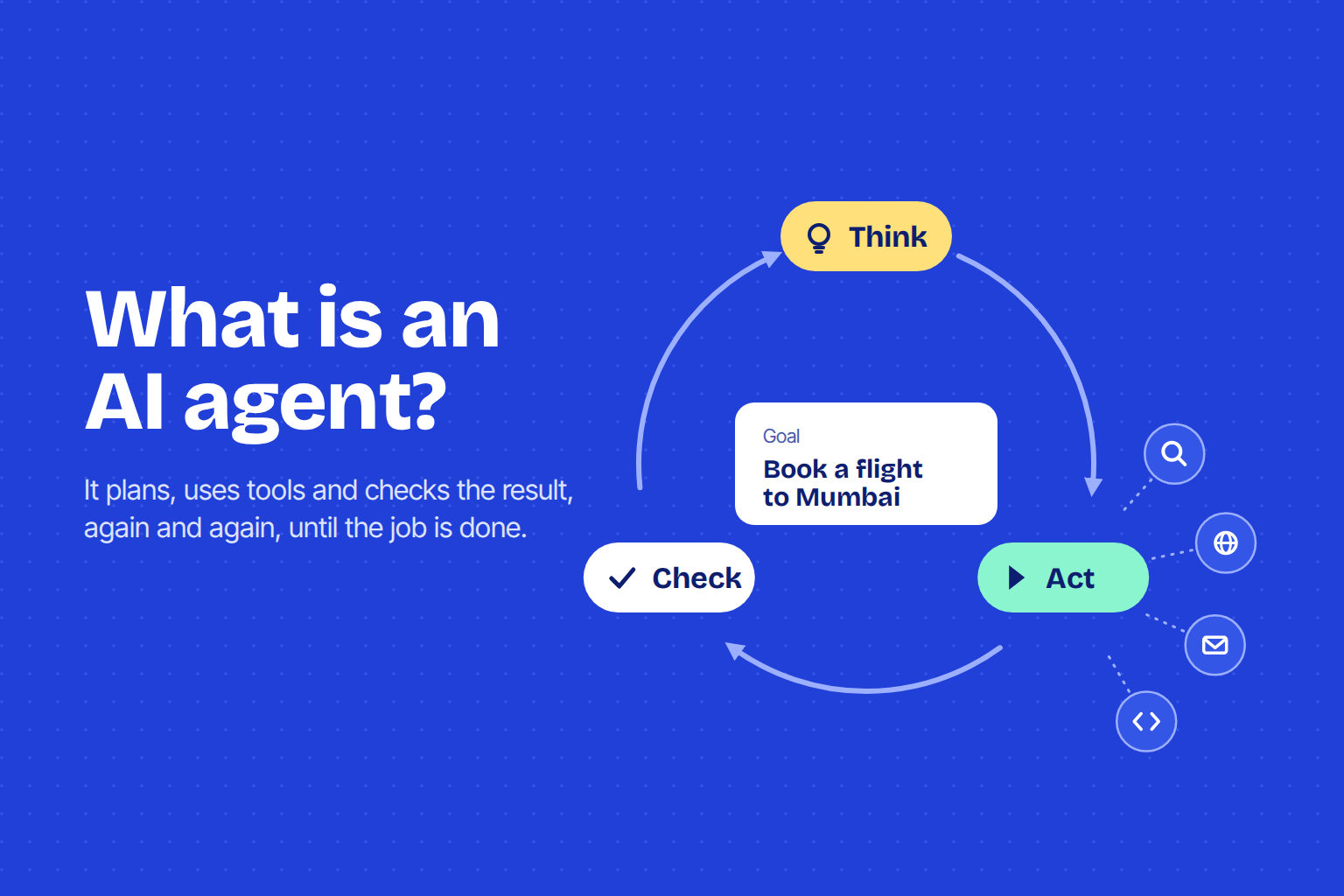
Ask a chatbot to help you book a flight to Mumbai and it writes you a checklist. Give the same request to an agent and it opens the airline site, compares fares, fills in your details and stops to ask before it pays. Same kind of model underneath. The difference is that the agent is allowed to act and then look at what happened.
The word "agent" is older than chatbots. The standard AI textbook by Stuart Russell and Peter Norvig, Artificial Intelligence: A Modern Approach, treats an agent as anything that senses its surroundings and acts on them. A thermostat qualifies under that definition. In current usage the term is narrower: a system built around a large language model (LLM) that pursues a goal over several steps using tools.
A widely referenced working definition comes from Anthropic's engineering guide, Building effective agents. It splits "agentic systems" into two kinds. In a workflow, the model and its tools follow paths that a developer wrote into code in advance. In an agent, the model works out its own sequence of steps as it goes, choosing which tool to reach for and when. This is one company's framing rather than a formal standard, but it has become a common reference point.
An analogy helps. A workflow is a recipe card: every step is fixed, and the cook only has to execute. An agent is a cook handed a stocked fridge and a goal, such as dinner for four with one vegetarian guest, and left to work out the steps, taste as they go and change course.
How it works
Most LLM agents are built from four parts.
- The model. The LLM does the reasoning. At each step it reads everything so far and decides on the next move.
- Tools. These are functions the model is allowed to call: search the web, run code, query a database, send an email. Through tool calling (also called function calling), the model writes a structured request, the surrounding software carries it out, and the result is passed back to the model as text.
- Context. The model works from its context window, the running record of instructions, actions and results it can see at once. Some systems add longer term memory, such as notes saved to a file.
- A stop rule. The job ends when the goal is met, a step or budget limit is hit, or a human checkpoint is reached.
Those parts run in a loop:
- Think about the goal and what is known so far.
- Act by calling a tool.
- Observe the result.
- Repeat until the stop rule is met.
The pattern was formalised in a 2022 paper from Princeton and Google researchers, ReAct: Synergizing Reasoning and Acting in Language Models (Yao et al., presented at ICLR 2023). It had models alternate between writing out their reasoning and taking actions such as looking things up. On two interactive test environments, a simulated household and a simulated online shop, the approach scored 34 and 10 points higher in success rate than older methods trained by imitation or reinforcement learning, even though it was shown just one or two examples.
A coding agent shows the loop clearly. It reads a bug report, opens the relevant file, edits it, runs the tests, reads the failure, edits again and stops when the tests pass. The test results tell the agent, and the human reviewing its work, whether each step actually helped.
Why it matters
Agents move AI from producing text to doing work. That changes what buyers pay for, what can go wrong and how progress gets measured.
The tasks are getting longer. The research group METR (Model Evaluation and Threat Research) tracks how long a task can be before an agent fails at it. Its metric, the 50% time horizon, asks a simple question: how long would a skilled person need for the hardest tasks a model gets right about half the time?. In its March 2025 paper, METR found that this horizon for frontier models had doubled roughly every seven months since 2019, with signs the pace picked up in 2024. The measure is built mostly on software tasks, so it says less about messier office work.
Businesses are cautious. Advisory firm Gartner predicted in June 2025 that more than 40% of agentic AI projects will be cancelled by the end of 2027, pointing to spiralling costs, doubtful returns and poor risk management. The same forecast puts the share of everyday work decisions that agents make on their own at 15% or more by 2028, against none in 2024. Both are predictions, not measurements.
Errors compound. Every extra step is another chance to go wrong. As a simple illustration, an agent that gets each step right 95% of the time finishes a 20 step task without a mistake only about 36% of the time (0.95 multiplied by itself 20 times). This is why Anthropic's guide advises starting with the plainest design that does the job and reaching for more autonomy only when a task demands it. For some problems, that means no agent at all.
Common misconceptions
"An agent is just a smarter chatbot." Often the model is the same one that powers the chatbot. What changes is the setup around it: tools it can call, a loop that feeds results back and permission to act.
"Agents run with no humans involved." Autonomy is a dial, not a switch. Builders decide which actions need approval, how many steps an agent may take and what it may touch. The flight booking agent that pauses before paying is still an agent.
"Anything sold as an agent is one." Gartner uses the term agent washing for relabelling older products, such as chatbots, assistants and robotic process automation (RPA) software, as agents when they cannot actually plan or act on their own. Of the thousands of companies selling agentic products in mid 2025, it judged only about 130 to be the real thing. A quick test: if code decides every next step and the model only fills in blanks, it is a workflow.
"Every AI project should be an agent." Agents give up some predictability to gain flexibility, and they cost more to run and debug. For a fixed, well understood process, a workflow or a single model call is usually cheaper and easier to audit.
What's next
As of 6 October 2026, four questions shape where agents go.
- Reliability on long tasks. Whether the task length trend continues, and whether it holds outside software.
- Security. An agent that reads web pages or emails can be fed hidden instructions, an attack called prompt injection. How much an agent is allowed to do on its own depends on how well that risk is contained.
- Connecting to tools. Shared standards such as the Model Context Protocol (MCP) aim to let any agent plug into any tool without custom code for each pair.
- Cost. Each loop means more model calls, so pricing and speed decide which tasks are worth handing over.
Tags
Related Posts
Enterprise AI
Why OpenAI and Anthropic Want Scientists Using Their AI for Free
23 hours ago

Enterprise AI
Microsoft Azure Revenue Grows 48% as Quarterly Capex Hits $45 Billion
1 day ago
Enterprise AI
Microsoft Offers Voluntary Exit Packages in US, UK, India and Canada
4 days ago
Enterprise AI
What is the difference between open-weight and closed AI models?
5 days ago